Labels

Showing posts with label INCOME TAX. Show all posts

Sunday, December 22, 2019

Understanding Affordable Housing under different laws

INCOME TAX - Sec 80IBA
The carpet area as per RERA of the residential unit comprised in the housing project does not exceed 30 sq mtr where the project is located within the cities of Chennai, Delhi, Kolkata or Mumbai [BCDC] and 60 sq mtr at any other place outside the cities of Chennai, Delhi, Kolkata or Mumbai.

GST
Total Carpet Area of the residential property cannot exceed 60 square meters in metropolitan areas and 90 square meters in non-metropolitan cities and towns AND Total value of property cannot exceed Rs.45 lakh in either metropolitan [BCDC BH]or non-metropolitan areas.

INFRASTRUCTURE STATUS
Affordable Housing is defined as a housing project using at least 50% of the Floor Area Ratio (FAR) / Floor Space Index (FSI) for dwelling units with Carpet Area of not more than 60 sqm.

CLSS
Scheme Type   Carpet Area - Max (sq.m.)
EWS / LIG         30 sqm** / 60 sqm**
MIG - I              160 sqm
MIG - II             200 sqm

Friday, August 16, 2019

Key Provisions of Finance Bill (No.2), 2019 w.r.t Real Estate Transactions

Tax relief for affordable housing - Section 80EEA

Individual buyers (not owning any other property at the time of sanction of loan) can claim deduction for interest on home loan up to INR 150,000 provided that loan is sanctioned by financial institution during the period 1 April 2019 to 31 March 2020 and stamp duty value of the property does not exceed INR 45 Lakhs.

TDS on purchase of immovable property – Section 194-IA

Presently, buyer is required to deduct tax at source at 1 percent on the amount of consideration paid on purchase of immovable property. The term ‘consideration for immovable property’ is currently not defined. Therefore, it is proposed to include all charges of the nature of club membership fee, car parking fee, electricity or water facility fee, maintenance fee, advance fee, or other charges of similar nature, which are incidental to the transfer of immovable property within the ambit of consideration for immovable property. This amendment shall come into effect from 1 September 2019.

Compliance of TDS by Individuals/ HUF not covered u/s. 194C or 194J - Section 194M

At present, an individual or HUF not subject to tax audit are not liable to comply with TDS provisions under section 194C or 194J. In order to fix this loophole, new section proposes to provide for levy of TDS on sum paid account of contractual work or professional fees at the rate of 5 percent where such payment exceeds INR 50 Lakhs in a year. For ease of compliance, individuals or HUFs shall be able to deposit the tax deducted using their PAN. It may be noted that proposed amendment will also be applicable where payment is made for personal purposes. This amendment shall come into effect from 1 September 2019.

TDS on withdrawal of cash - Section 194N

This section casts responsibility on Banking company, Cooperative society, Post office to deduct TDS at the rate of 2 percent upon payment of any sum or aggregate of sums in cash in excess of INR 1 crore. However, Bill does not clarify if such limit of 1 crore applies to each bank or bank accounts or aggregate of payments from all banks. Also, it has to be clarified that though cash withdrawals are not income, credit of TDS will be allowed.

Source: ICAI Journal

Wednesday, December 5, 2018

Important Judgement on Capital Gains Exemption to Include Cost of Land

Real Estate and the provisions of Capital gain go hand in hand for buyers of real estate. Sharing a recent judgement passed by the Hon'ble Madras High Court on a capital gain exemption under section 54 of Income Tax Act.

C. Aryama Sundaram Vs. Commissioner of Income Tax, Chennai dated 06th August, 2018

The assessee sold a residential house property resulting into long term capital gain of Rs.10.47 crore. Thereafter, the assessee purchased new property with superstructure for a consideration of Rs.15.96 crores. After demolishing the existing superstructure, the assessee constructed a residential house and claimed the exemption under section 54 towards the cost of the construction and the cost of the land.

The Assessing Officer (AO) held that only that part of the construction expenditure which was incurred after the sale of the original asset was eligible for exemption under section 54. The AO, thus allowed an exemption of Rs.1.14 Crores under section 54. The Commissioner of Income Tax (Appeals) upheld the order of the AO. Income Tax Appeallate Tribunal (ITAT) remitted the matter to the file of AO to consider the deduction under section 54 for construction cost incurred by the assessee. 

Aggrieved, the assessee appealed before the Madras High Court. High Court analysed the provisions of Section 45 and Section 54 and noted the conditions precedent for claiming exemption under section 54. High Court observed that what has to be adjusted and/or set-off against the capital gain is, the cost of the residential house that is purchased or constructed and not just cost of construction of the new residential house. Thus, it is the cost of the new residential house and not just the cost of construction of the new residential house, which is to be adjusted. The cost of the new residential house would necessarily include the cost of the land, the cost of materials used in the construction, the cost of labour and any other cost relatable to the acquisition and/or construction of the residential house. 

High Court stated that Section 54(1) of the said Act does not contemplate that the same money received from the sale of a residential house should be used in the acquisition of new residential house. Had it been the intention of the Legislature that the very same money that had been received as consideration for transfer of a residential house should be used for acquisition of the new asset, Section 54(1) would not have allowed adjustment and/or exemption in respect of property purchased one year prior to the transfer, which gave rise to the capital gain or may be in the alternative have expressly made the exemption in case of prior purchase, subject to purchase from any advance that might have been received for the transfer of the residential house which resulted in the capital gain.

High Court, thus held that the cost of new residential house would include the cost of construction as well as cost of land for the purpose of claiming exemption under section 54. High Court, thus ruled in favour of the assessee.

Source: ICAI Journal
click here for a detailed judgement

Friday, November 23, 2018

SIMPLIFYING THE CONDITIONS OF SEC 80 IBA vis a vis Affordable Housing

In the recent past, there has been a lot of discussion in the builder community on Affordable Housing vis a vis the Income Tax deduction as per the provisions of Sec 80-IBA of Income Tax Act.

Let me take this opportunity to decode the above statement by bringing to your notice that the above statement is a combination of two different provisions.

Firstly, the provision of Sec 80-IBA of Income Tax Act which speaks about the deductions in respect of profits and gains from housing projects.

Secondly, a notification no. 13/6/2009-INF issued by the Ministry of Finance dated 30th March, 2017 which incorporates a new sub sector "Affordable housing" under the category of "Social and Commercial Infrastructure"

Now, lets understand the conditions imposed under sec 80-IBA to claim a deductions in respect of profits and gains from housing projects

Majorly, the conditions of 80-IBA can be divided into six categories, detailed as below

A. PROJECT
  • should be only housing project on the plot of land
  • project approved after 1st June, 16 but on or before 31st Mar, 2019
  • to be completed within 5 years from the date of approval
B. PLOT AREA

  • land measuring not less than 1000 sqm in Mumbai, Kolkata, Delhi Chennai
  • land measuring not less than 2000 sqm in any other place
C. FAR UTILISATION
  • not less than 90% in Mumbai, Kolkata, Delhi Chennai
  • not less than 80% in any other place
D. CARPET AREA
  • Residential Unit
    • should not exceed 30 sqm in Mumbai, Kolkata, Delhi Chennai
    • should not exceed 60 sqm in any other place
  • Shops and Other Commercial Establishments
    • should not exceed 3 % of the aggregate carpet area of the project
E. ALLOTMENT
  • Allotted to an Individual
  • No other unit shall be allotted to the Individual or the spouse or the minor children of such individual
F. BOOKS OF ACCOUNT
  • assessee should maintain separate books of account in respect of the housing project


Notification of Ministry of Finance vide notification no. 13/6/2009-INF dated 30th March, 2017 brought affordable housing within the ambit of Infrastructure sector and defines affordable housing as below -
"Affordable housing is defined as a housing project using at least 50% of the Floor Area Ratio (FAR) / Floor Space Index (FSI) for dwelling units with carpet area of not more than 60 square meters"
Notification no. 13/6/2009-INF issued by Ministry of Finance dated 30th March, 2017

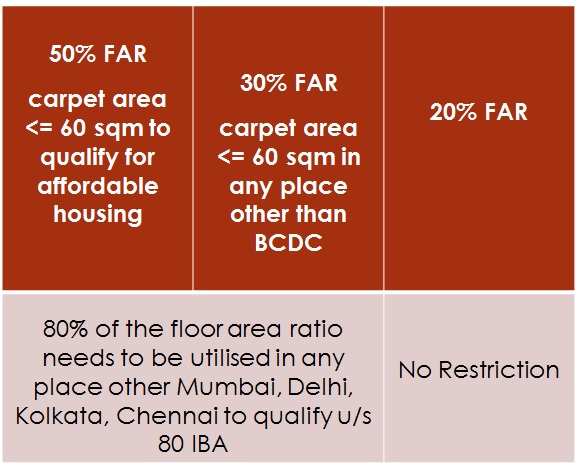
Thus, a net inference from the conjoint reading of both the clauses i.e., to develop an affordable housing and claim the benefit of profit deduction u/s 80-IBA, will be something like this  -


MASTER STROKE by the central government of India in defining affordable housing with FAR utilisation of 50% with a restriction of 60 sqm carpet area AND giving benefit u/s 80-IBA with a FAR utilisation of 90% / 80% and a restriction of 30 / 60 sqm of carpet area within the cities of Mumbai (B), Kolkata (C), Delhi (D), Chennai (C) and any other places respectively.

I hope this article will help in understanding the joint inference of the provisions of sec 80-IBA and affordable housing.

Please give your valuable feedback in the comments below.